Saturday, March 16, 2013

Spain! Starting in Barcelona: a museum full of ruins.


I just got back from this trip, uploaded all the photos, and am parceling out and editing the notes I took as I went.  The trip was for 2 weeks, with 4 or so days in Barcelona, and the rest jumping around Andalusia.

We were in Barcelona and doing interesting enough things there that I am splitting that part up into three chunks. The agenda after Barcelona was:

Málaga
Granada (to see the Alhambra)
Córdoba
back to Madrid, mainly to be able to fly out. 


Day 1: Hamburg to Madrid. 
Hamburg is actually sort of an inconvenient airport to fly out of, despite it being Germany's first airport. There are almost no direct flights to anywhere, so one always have to connect through another airport, which drives up the prices. This time, I'm flying Brussels Airlines, which is a step above EasyJet and maybe the same tier as airBerlin. That ends up meaning that while there is, technically, a ''business class'', an ''economy plus'' and the rest of us, the line between is not drawn thickly. Business class passengers do not get a little curtain between them and the rest of the plane, or comfier seats. They *are* guaranteed a seat in between them and the other person (so, all seats are aisle or window) and free snacks and beverages. I think they were offered 4 types of snacks in the course of our 1 hr flight.

Something about European flights -- their carryon-bag restrictions are tighter than the states. So, everyone has these teeny tiny carry-on bags. They're cute.  Everyone who's not EasyJet allows you to have one checked bag and one rather tiny carryon. So, rather than as in the states, people check a smallish bag and maybe take a tiny wheely bag as well on the flight. Maybe this speaks more to the purpose of most flights. Maybe most inter-Europe air travel is business-related. 


We spent the first night at Hostal Alaska, which has a very small sign and a very unobtrusive door on a street off of Plaza del Sol, which is clearly a very major train stop. The plaza was covered with people in various costumes and also ones doing the whole 'statue' gimmick. Also guys wearing vests which advertised a place that buys gold (weird).  

Walking around looking for food, we came across this mural: 


Day 2: Madrid to Barcelona. 
Breakfast was sandwiches (on toasted white bread). I got one with salmon (and egg, apparently) as well as a coffee. We ate at a place on the Plaza del Sol that seemed easy to order from, and wasn't particularly remarkable. 

We made our way to the Madrid train station, where C. (thankfully fluent in Spanish) figured out how to turn our tourist 4-trip passes into actual train tickets.  We passed by the inner area of the train station that was very lush and tropical and had some turtles: 

Around the corner was a store that sold skull balloons with bows: 

We took the Renfe (high speed) train from Madrid to Barcelona (going ~286 km/hr),  which took about 3 hrs. There was even an in-train movie. 

It was not until we got to Barcelona and our second dwelling place (via airbnb) that I realized that in Spain, they do sheets like we do in the states. And quilts/light blankets on top. Turned out, we were right around the corner from Sagrada Familia:


Here was our view:

And our balcony, which it was too cold to really use:


Lunch was what we prepared after going through a grocery store (full of delicious meats, which my companions do not eat but which i bought myself a selection of). We went to a real bakery (Supan ("your bread")) and got the most German-looking bread, which is apparently made with spelt flour (in German, it's "Dinkel", and is also a very common flour).  Also got some sheep's milk cheese that was like a soft manchego. I thought it was delicious. Two of our party thought it tasted like feet or smelled like fish (weird). 


After dark, we went by the Sagrada Familia (we stayed quite nearby) and took some pictures.  


We also found a columbia bakery and had some delicious foods, as well as some weird Yucca bread:


Day 3: Museum of History of Barcelona, etc. 
This includes stuff from Roman-colonial-era of Barcelona up until Medieval times. 
The timeline is roughly:

  • [~11 B.C.] Roman Barcino
  • [2nd Century] Textile processing/dying factory. 
  • [3rd Century] Garum(fish sauce) factory. 
  • [3-4th Century] Wine-making. 
  • [5th-6th Century] Roman bath, built atop the garum or the textile factory. 
  • [4th Century] (still Roman) defensive towers and remains of workshops. 
  • [6-7th Century] Church & Necropolis. 
  • And then more churchy stuff. Maybe also a hospital at some point. 

Our self-guided tour started in the stuff excavated from the original Roman colony of Barcino, from about 11 BC.

Some random Roman writing supplies:


Remains of a Roman street, and diagram of said street:


We first saw the "garum"(fish sauce) and salted fish 'factory'. In case you like diagrams of archeological  sites, here's the bit on the `garum' era:


Later in the tour, but earlier in time, it was a textile producing place, where people dyed fabrics. You could see the troughs and the special-made floors used in this process, some still with traces of Egyptian blue dye. On top of that, but later, the Romans had built a bathhouse, of which remained the cold water pool.  

Laundry-washing floor:


Dying trough:


The remaining cold water pool:


4th Century Roman times yielded a few towers, one of which was left (still underground, but mostly intact), built using stones from the older Roman structures (evidenced by some stones with inscriptions being used on their side in the construction).


A sewage channel added in about the 4th Century A.D.:


Wall of workshops and street by the sewage channel (also 4th Century A.D.?):


Then there was the wine-making part, 3-4th Century A.D. It was on the same level as the dyeing and fish-stuff-making parts, and had neat giant round pottery in which the wine was stored.

Diagram of the wine-vat area:


The vats themselves:


In the 6th Century, there was a Church-Palace (it said "Episcopal Palace") and Necropolis built atop. There's a really great part of this where they reinforced this layer, and you are looking at the roman courtyard with the leftover column slabs (just the first stone or so) and then past the courtyard, you see the Roman mosaics, there's about 2 ft of air, this reinforcement, and the wall and windows of the 6th Century building atop.

6th century church-palace on top, roman mosaiced courtyard underneath


another view of the mosaic


This is a view of what had been the peristylium (i.e. courtyard) of the 10 B.C. Roman household (looking down at the pillars that had surrounded said courtyard, tucked under the 6th Century church):


Diagram of the Church and Necropolis era of the dig:


Necropolis-era pillars:


More Necropolis-era pillars:

There was yet another church-structure built atop this, a gothic cathedral.  Later on, I think it was also a Jewish hospital (there was something like a dedication stone, with a Hebrew inscription). 


The whole thing is well designed, with floors or ramps installed between the different eras of buildings. It was really delightful. 

Diagram of Roman streets under exit of current era cathedral


Emerging from all this into the last layer of cathedral (show on the pic above), part of this gothic cathedral houses an exhibit on calicos (fabrics which were originally imported from India), and how Barcelona started producing them and this leading to Barcelona going from a town of craftsmen to a town of factories, which necessitated tearing down the city's wall.  

Calicos made in Europe were originally made by hand-stamping the designs onto the fabric. Later, there was a series of drums/cylinders one could roll over the fabric (makes me think of a printing press), one for each color in the pattern.

some old-style calicos


stamps used to make calicos

diagrams of machines involved in the process


The tag says: "Model of a stationary steam engine, similar to those used in Barcelona in the second half of the 19th Century"


Later-era roll for stamping calicos


The exhibit included the debate about the wall-tear-down and how the factory growth and population boom necessitated it for safety's sake. I saw a map of then-Barcelona, which included a Citadel. This prompted me to look up the history, which is awesome. 

[ASIDE ABOUT AWESOME CATHEDRAL DESTRUCTION:]
TL;DR -- Spaniards built citadel to keep Catalonians in check, who later destroyed it from the nearby fortress on Montjuïc.


Barcelona, in 1714, fell to Philip V of Spain (War of the Spanish Succession). To maintain control and try to keep the Catalonians from rebelling (like they apparently had been doing the previous century), he built the citadel, which was the largest in Europe at the time. 

Diagram of the old citadel [wikimedia commons pic]

[By the way, I recommend the wikipedia article for hilarious and mis-used English. E.g. "...was destroyed to obtain the necessary space, leaving its inhabitants audaciously and carelessly homeless"   and "[h]undreds of Catalonians were forced to pertinaciously work on the erection for three years".]

Time passed.  

Timeline:  
  • 1841 city decides to destroy fortress. 
  • 1843, new regime (via its queen) says restore it! 
  • 1848, after abdication of the queen,  "General Espartero razed most of the buildings within the fortress with its walls to the ground by bombarding it from a nearby mountain fortress Montjuic, which helped him beget political popularity. "(This made me really want to go see Montjuïc)
  • 1869: new General (Prim) turned over the rest of the demolishment of it to the people, as it "was viewed as by the citizens as a much-hated symbol of central Spanish government".  
[END OF ASIDE ABOUT AWESOME CATHEDRAL DESTRUCTION]

Walking out and past out cathedral to lunch, there were the rest of the 4th Century Roman fortifications:


We also passed this super-skinny building (on the left of this picture):

And a storefront that had some really classy alcohol:


S. was stealthily trying to take pictures of the Barcelona people who were walking around in fur or down coats, by the palm trees/plants, in our ~12C weather. Here's my attempt at such a pic:


Nearby was some awesome graffitti:

Later on, we made it down to the waterfront and Rambla del Mar.

Cool statue/fountain of dude with a star:


I liked the "palace" of post and telegraphs, which was very fancy:


Down by the water there was a really cool buoy: 


I liked this Archangel Michael statue we came across. It looked like he was ready to get to business: 


Due to the coastal clime, there were also (small) parrots, rooting around with the pigeons. Some of them were tagged, even:


On the train, we saw a group of guys who sounded like they were from the states, all with tricked-out scooters. This was one of the guys:


We also passed the following note in Catalan:
Urgent girls for massages  -- 24hs -- 20-30 yrs/old   (?!?!?)


C's pedometer said that at the end of the day, we'd walked about 6.5 miles (~10.5 km) [spoiler: that was about average the entire trip, outside of one day].

Wednesday, February 13, 2013

One year abroad: retrospective (on Germany)

This time last year, I had been in Copenhagen for a month, and a month away from starting to work in Hamburg. Seems like a good time to give a retrospective.

I've travelled a good bit, which has been a mixture of nice and exhausting, seeing new places (Sion, Bern)  and revisiting ones I've seen (once) before (Paris, Amsterdam). I've tried to keep my tone upbeat, but when I've felt smooshed by life, I kept it to myself, which explains some of the blogging breaks which occurred even though I had things I could write about.

Since we all love lists, here are some lists:


Things that are pretty great here:
It's harder to fire people. So, people are not constantly stressed out about possibly losing their jobs. Which I think relates to higher job satisfaction, and people in jobs that one would see staffed by teenagers being instead grown adults who are pretty knowledgeable with what they're selling you.

Teachers are respected. I notice this as a trickle-up thing from the Kindergarten through highschool age range. Teachers here are treated pretty well, respected, and it's actually pretty difficult to get into school with education as your major, since they have so many applicants and can pick and choose.  Example of teachers being treated well: I'm subletting from a guy who teaches Econ and Spanish. He is on sabbatical. It lasts a year. A year he is spending sailing around on his boat (with a break now during winter to hang out in Argentina, waiting for it to warm up a bit).

"Serious, 'bone-crushing' debt" from school (university) is, at most, something like 8000 euros (btwn 10 and 11k USD).  We had a chat in my German class about debt and credit and student loans here, and I explained how I knew plenty of people with debt around 30-50k USD, and a few more like 200k USD (doctors, lawyers).

People here are not afraid of losing all of their money to medical bills. 
This doesn't happen, and it's not something I can explain or justify about the US. In the States , there are so many "heartwarming" stories of people donating to various causes, but there is a sadness, too. That the "need" for these donations and fundraising drives is even there. That otherwise, these people would die or be extremely suffering.
Examples of what I mean:

  1. Boy wins $1000, donates to neighbor with Leukemia, "to help pay for the medical care "
  2. Regretsy has had many fundraisers for people in awful situations, some involving medical-bills induced debt, etc. For example,  a person who's "dad was diagnosed with lung cancer. Despite surgeries, aggressive chemo and radiation, it spread to his liver, spine, and brain. My mom became the sole income-earner for the family. Medical bills in the hundreds of thousands of dollars were piling up, and somehow she still managed to sit with my dad 24 hours a day when he was in the hospital."  Dad dies, family still has bone-crushing debt.  Regretsy raised ~7k. 

(Less seriously...)

  • General multi-lingual-ness. There's a guy in one of my previous German classes who speaks, with some high fluency: French, Dutch, English and (now) German (he's from Belgium). This is pretty normal. 
  • bicycles! It's pretty normal for people to get around mainly by bicycle.
  • There is surprisingly affordable watch repair, probably related to  the fact that people here seem to tend to own (nice) watches.
  • Cell phones are usually/often not locked to one provider. There is always a prepaid option.
  • Fast food places at, say, the mall will have a sit down area and real silverware and plates
  • Taxes included in the price of things.
  • Tipping not particularly expected. Not refused, but not assumed. My hairdresser was very surprised and a bit flustered when I tipped him 5 euros, and asked me if I was sure. 
  • No ice in drinks (which then means that you actually get the volume that you paid for). 
  • Cheap wine/alcohol. Lots of new and strange alcohols. Ginger schnaps is awesome. I am wary of the "Egg liquor" (which is, I think, rather different from eggnog). 
  • Staff in stores are almost always helpful. 
  • Things are generally safe. Related: normal people use public transit. 
  • Lots of random Holidays. Surprisingly large amount of vacation time.
  • Leather shoes. Leather-soled shoes. These things are pretty normal. I think it would actually be hard for me to find non-athletic shoes which are non-leather, at least for the uppers. 


Ways I've changed/things I've taken on:
Duvets and duvet covers. The european bed-linens are comprised of: a fitted sheet and a cover for the duvet/comforter that comes with one or two matching pillowcases.  Takes some getting used to, but washing duvet covers are certainly a lot easier than washing comforters.

Anti-SAD lamp I've been feeling the cloudy days and finally broke down and got one of these lamps for the office. I find the light very soothing. 

'Korn'y bread-- I'm not generally a big eater of bread, as I view it as empty calories. This bread is different. It's dense and heavy, full of seeds and similarly unprocessed/un-ground things and usually rolled in more seeds before baking, for good measure. Someone had to ferment the dough to make it rise at all, I'm pretty sure. You could probably beat someone up with a full loaf of this stuff. I think it's awesome.  My current favorite is the "Fiticus Fladen" at "Dat Backhus". Here they are from the outside, and once you cut into them (not my pics).

Abendbrot(evening bread)-- The German model for meals is :
  • small/no breakfast (or maybe a roll and some jam or coldcuts ("Wurst"))
  • large, warm lunch 
  • small dinner, basically breakfast again. Thus the name "Abendbrot" (Evening bread).
I've downsized my dinners and taken to eating lunch in the cafeteria rather than bringing in my own sandwiches. The cafeteria (Mensa, in German) isn't particularly great, but sometimes alright.


Not wearing (so many) "funny" shirts.
 I'm kind of sad about this, since I stopped wearing them as they are not funny here, and instead cause general consternation.


Scarves! Germans love scarves. They are (as I see it) the poor man's jewelry. Also, much easier to see, and practical (since the weather is, counter to what Fox ''news'' would tell you, mostly overcast/cool). I've got my own collection of them. They're great.

From Germany 2012-2013


Things I'm still not used to:

Being called "Frau". If I can avoid it, I do. 

Popcorn is always sweet, never savory. I haven't tried it, assuming it's like sweet popcorn in the states.

Movies, TV, everything from not-Germany -- dubbed. Not verbatim, though. They change the script  to adjust for the sort of latent assumption that "everyone involved is German". Example: In Captain America, it's key that one of the characters knows (some) German and can therefore listen in on German radio transmissions and also help in figuring out the buttons to get a tank to start. This, of course, makes no sense when everyone is dubbed to be speaking in German. There's a comment (in English) that he took German class but switched to French because the girls were cuter.  This got changed to him saying he was in mechanical engineering for a bit (which is why he knew how to start the tank) and switched to (something, can't remember) because the girls were cuter. Riiiiiiight.

and, of course:

German, the language. I'm much more fluent than I was a year ago, but still have a ways to go. I still think in English and translate everything between. It makes for some errors, and I also find myself grasping for words in either language, at times.

I find the struggles of Mark Twain inspiring. He gave a speech (in German) on "The Horrors of the German Language" in Vienna in 1897 (here, in German and with his 'literal' translation adjacent)  and also had a bit to say after tramping around the country:

 "A person who has not studied German can form no idea of what a perplexing language it is. Surely there is not another language that is so slipshod and systemless, and so slippery and elusive to the grasp...Every time I think I have got one of these four confusing "cases" where I am master of it, a seemingly insignificant preposition intrudes itself into my sentence, clothed with an awful and unsuspected power, and crumbles the ground from under me." (Twain, "The Awful German Language", appendix to "A Tramp Abroad"). 


Fun things:

  • There is no word in German for "pie". 
  • The word for "groceries" in German is Lebensmittel, which translates literally to "stuff you use/need to live". 
  • "Gymnasium" is what we might call High School (or maybe college-prep High School), whereas "Hochschule"(literally "High + School") is a general name for college/uni-level schooling. 
  • The slogan for Ritter Sport chocolate bars is "Quadratisch, Praktisch, Gut", which means "Square, Practical, Good". 
  • There's a word for yes-and-no. "Jein" = ja+nein. 
  • "die Schlabberhose" = baggy pants 
  • "brav" means "well-behaved" (e.g. a word you might apply to children) while "mutig" means brave ("Mut" is courage/bravery). 
  • All soft drinks are "Limonade". Which is apparently not confusing, since lemon = "Zitrone". 
  • "hamstern" = to hoard. I saw an advertisement for a bank or maybe a credit card that had the word "geldhamstern" (hoard money). 
  • Yiddish is, since about 3/4 of its words are pretty directly from German, listed as a German language, albeit written with Hebrew(esque?) script. Having spent many formative years in NY(not the city), I think I absorbed a fair about of Yiddish words into my English. It's funny running across these in German (where they can have rather different meanings). 
          E.g. "Schmuck", in German is "jewelry". 
          "Schleppen" means to haul/carry/drag (like in Yiddish, "schlep").  
          "Klatsch" = gossip.  
          "phooey" from "Pfui" (German). 
          "Shtup"(Yiddish) comes from "stupfen" (German), 'nudge or jog'. 
           For more, see this list including etymology.
       
we make not other as others, only other! (roughly?)
From Germany 2012-2013


Things that are hard to find:
Brown sugar (or molasses). I think I have never seen this. Not 'proper' brown sugar (which is sugar+molasses). That have what I would call "golden" or "raw" sugar, and call that brown sugar.

Reece's peanut butter cups [I did find these at a video rental store in Berlin]. Or, any candy with peanut butter. Peanut butter itself is enough of a novelty that I can find it in almost every grocery store.

Tap water in a restaurant (outside of the Canadian-run breakfast/diner place, Mamalicious).

Good, very-thinly cut bacon. They have bacon (and label it as such), but it doesn't cook up as well as I'd like.

Decent Mexican food supplies. I saw masa harina at an indian grocery store and chipotles in adobo sauce at a store near a "Mercado", but...while a lot of grocers have an "international foods" section, the mexican stuff is generally lack-luster.

Metal water bottles, specifically made out of steel. I brought one back with me after christmas.

Pillows or even trash cans (that contain more than a liter) that cost less than 40 euros.


I'll leave you with a random picture. Me in my office, with a lazily-done braid.  Another person on my floor called it a work of art, so I took a picture to get a look at it. Looks normal to me.

From Germany 2012-2013


Sunday, January 27, 2013

a handful of (mainly) Hamburg museums and sights (Dec 2012-Jan 2013)

I'll sort these in reverse chronological order, for no real reason outside of the most recent things being what I probably have the most to say about. To be fair, a good bit of some of it is just pictures, so it shouldn't be as monstrously long as it seems.
  1. Hamburg's Museum der Arbeit (Museum of Work)
  2. Berlin Unterwelt Tour: Cold War era and (Berlin) Jüdisches Museum
  3. Dialog im Dunkeln (I might call this a "blind museum")
  4. Ballin Stadt (Museum for Emigration through Hamburg to North and South America)
  5. Deichstrasse (pretty and old houses in Hamburg, rare sight indeed)
I was visited by a friend who is (back) in Germany doing more research towards her Ph.D. This was the first weekend of 2013; we went to the Emigration museum, Deichstrasse, and the Dialog im Dunkeln. It was a bit of a busy day. 


1. Museum der Arbeit

Last weekend, we looked up the list of Hamburg museums and picked one that looked interesting. This ended up being the Museum der Arbeit.

The museum itself is housed in what used to be a hard-rubber factory for the  New-York Hamburger Gummi-Waaren Compagnie AG . Here's there awesome neon logo:

From Germany 2012-2013

Accordingly, there's a section of the museum dedicated to the discovery and development of rubber, from its infancy and initial uses for just about everything to the exportation of rubber plants and a small amount of commentary on exploited workers (the harvesters of the raw material were enslaved natives).  The raw material is called "Kautschuk".

Cool new material, what should we do with it? Make statues of course!
From Germany 2012-2013


Here are four stages of worked rubber, from somewhat raw, to heated. These are/were the initial steps towards turning it into, say, a comb (the label says "Kautschak auf dem Weg zum Kamm" --  pre-rubber on the way to (becoming a ) comb) .
I'm a sucker for big old maps, so here's one in case you are as well. Probably can't see from this, but Russia and Siberia are labeled as if they were different lands (maybe they were then).

Here's a travel poster that is in the map vein as well: 

The museum went on from all the crazy stuff you can make out of rubber to how people visited the places where it was made, the form it took when shipped, and other things one exported from these places (like cocoa beans). Here's an awesome travel suitcase:

Yeah, those are drawers. 
From Germany 2012-2013

After this were machines of various ages. Two children, maybe 10 or so, were happily and loudly banging away on some old German typewriters. It's good that those things can take a beating. I did a loop of the floor, and I think the kids were there for at least half an hour, kind of amazing they found it that entertaining. While I was near, a lady felt the need to come up and tell them that typewriters are what pre-dated computers.

Nearby was also an old calculating machine that was at first glance a bit complicated. You were allowed to play with this one as well:
From Germany 2012-2013

Down the way were the big machines. First, a ginormous press for newspapers and such:

From Germany 2012-2013


There were also a working Monotype machine and a working Linotype machine.

Here's the Monotype machine setup:
From Germany 2012-2013

closer-up picture of where the letters get spit out
From Germany 2012-2013


Closer up on the keyboard. Top row was cursive. I don't remember the difference between the green and white keys.
From Germany 2012-2013


This thing (which he called the/a matrix) is used by the setup to the write to figure out letter spacing. The output of the machine is a line of metal (iron) letters, like those in the right/upper part of the picture:
From Germany 2012-2013


I took a video (small enough I could upload it and get it to play) of the Monotype machine working (warning: quite loud):

From Germany 2012-2013


I checked out another floor of the museum, which was about professions and how they've changed (e.g. copper smith, roof-builder, etc.). This was my favorite display:

Label says: Sex work. Work boot. 
From Germany 2012-2013

This was a bit random. I like translating "Gewinn" as "win", but it's more like "profit, gains".

A sense of order brings win (profits/earnings)
From Germany 2012-2013

Something else. According to them, Konrad Zuse in 1941 developed the first fully programmable computer in the world, the Z3. I've never heard of this guy, but apparently Wikipedia agrees. ["His greatest achievement was the world's first functional program-controlled Turing-complete computer, the Z3, which became operational in May 1941."]

2. Berlin Underworld Tour: Cold War era,  Jüdisches Museum

These two go together because the happened the same weekend, two weekends ago.

(i) Underworld Tour
I have no pictures of the Unterwelt Tour, sadly, since we weren't allowed to take any. I'd still like to comment on it.

The tour we went on was "Tour 3": Subways, Bunkers and Cold War. The English tours that day were, of course, all sold out, so I plunged in with a German one and tried to stand as close as possible to the tour guide in hopes of being able to hear him clearly. Also -- they hold one French tour per day, and have several other languages offered on and off during the week, which is pretty cool.

The premise of all this is the following: Berlin has a lot of retired bunkers/bunker-like spaces spread around various U-Bahn stations on the very eastern edge of West Berlin.  After WWII, with the advent of the cold war, people thought that they should be prepared in the case of WWIII/a nuclear catastrophe. Berlin as a town for this to happen in would be weird, I think, being so divided between countries. Maybe this was part of the rationale behind their being utterly unprepared. Between all of the shelters in the town, they could hold something like less than 1% of the population, for some duration of time. Comments that were made: Switzerland had ~140% capacity. That is, their population + another 40%. Sweden was something like 99%.

The first bunker we entered wasn't finished (funding?), so was labeled as a place where you should hide out for at most 10 hours. Why? Well, no water, minimal air circulation/filtration and no other supplies.

The second bunker was a bit more practical. It was outfitted for exactly 14 days worth of fuel to power the air pumps/filters, food to feed people, etc. Lots of beds, and the train stop it was built around also had special bed-filled cars (if I understood correctly).

The trippiest part is that these are all nestled in/above/around active train stations. Tons of people walk by these doors ever day and have no idea that there are retired bunkers behind them.

(ii) Jüdisches Museum 
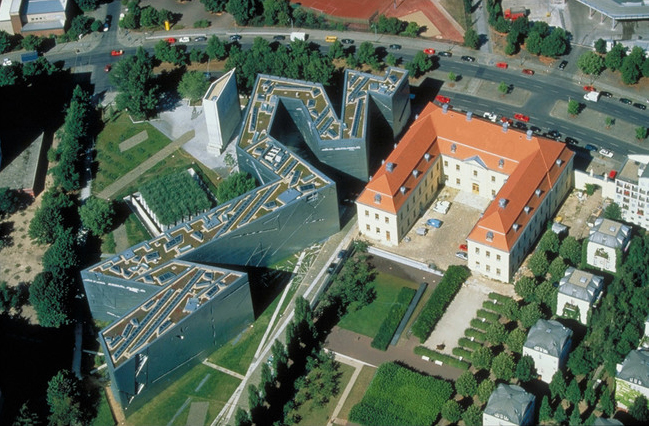
I suppose I was expecting another shocking tribute to the atrocities of war. I'm sure that can be found in this museum, but that was certainly not the only point. The building itself is giant (5+ floors of stuff) with gouges out the side that serve somewhat as windows.

[Not my pic, taken from the wikipedia page]
[Again not my pic. This is from the inside, during the day, out the slash windows]

[Again wikipedia source; the squiggle on the left is the museum (aerial view)]
Started at the top floor. This begins with the first mention of Jews in the area now known as Germany, in a proclamation dated something like the year 8, AD/CE, saying that Jews were no longer exempt from (onerous public duty whose name I forget).  I made it up through to just pre-WWII before the museum closed.  It was not exactly linearly laid out, so I have a few pictures of more modern things as well. 

There was a lot about various periods of persecution. I was surprised by something they didn't mention; they did mention that the Jews were blamed for the plague. They didn't mention that this was related to the Jews not really getting the plague so much, which I have heard attributed to the (ritual) hand washing before meals. 

Here's a pair of statues that apparently have shown up in many Churches (as statues or in paintings).  One represented Christianity(Ecclesia) and the other Judaism(Synagoga). Synagoga's blindedness is meant to portray that Judaism is "blind to salvation". No explanation of the broken lance she's holding, however.  There's a church in Strasbourg and also one in Bamburg that have these sorts of statues still:
Left: Ecclesia (the church;Christianity), Right: Synagoga (the synagogue;Judaism)
From Germany 2012-2013
There was quite a lot about Glikl bas Juda Leib (1646-1724), who had a ton of children, ran her husband's business after he died, and successfully married all of her children off to good families/business contacts. The museum didn't have a lot of originals of anything in the areas I saw, but it had a lot of very good facsimiles, including the re-written copies of Glikl's diary which her son had made. 

The early 1900s and on were a time where Jewish families were seen to be adopting more of the customs around them, e.g. Christmas trees, as a result of gaining more rights as citizens and integrating. Here's a comic (used as a tree ornament) poking fun at this development: 

"Darwinism"
From Germany 2012-2013

There were a lot of sort of mini-exhibits, character studies of various Jews of that time period. Here was one who was quite interesting:
From Germany 2012-2013

The label on the following bit says "Dildo box. Japan, jade, horn, metal wood. This dildo box is a remnant from the Institute of Sexual Research, which was destroyed almost entirely in 1933":

 They have a collection of Bar Mitzvah yarmulkes/kippahs which were pretty cute:
From Germany 2012-2013


And here's a wedding contract written in Chinese by a rabbi for a couple who were in exile in China, 1944:

From Germany 2012-2013


3. Dialog im Dunkeln
Understandably, I have no pictures of this, being a sort of "blind museum". Your tour guide is blind, and you're led through absolutely complete darkness by them. You get a walking stick, although i honestly made more use of my hands, groping along the wall and such. Rooms have things in them for you to find (e.g. spices, or fruits) and we even had a little boat trip (indoors) all navigated in the dark, with the helpful suggestions of our tour guide. I learned some new German through this.

die Gelände, which I knew before, means "grounds". E.g. "Messe Gelände" would be "Convention Center grounds".

das Geländer, which is pronounced almost identically to "Gelände", depending on the person, means "railing."

I spent a room or two wondering why the guy was telling us that there were "grounds" to our left or right. And then I bumped into the railing after he'd mentioned "Gelände(r)", and realized what he'd meant.

It was a bit scary, but I do make a regular habit of going around wherever I'm living in the (semi) dark, so it was not as foreign as it could have been.  The best/most challenging really was the end, where we were in a "dark bar". The servers were all blind, and fetched us something to drink or a snack, which we then had to pay with with the change (1 or 2 euro coins, hopefully) we'd been told we should bring with us. They could tell the coins by feel immediately.

The only trouble was the one guy who brought in a 10 euro note. He wasn't 100% sure it was a 10 euro note, so the guy taking it had to get out his ''comparison'' bills:  So, each euro bill is a completely different size. This is great, if you have them all together to compare against each other. Our guide said that his solution is to get the ATM to give him only two kinds of bills (so he knows which is which since he knows which value is the larger/smaller).  I bought a box of chocolate milk, and had some real trouble figuring out where (and how) to stick the straw in, which the woman serving me helped me find in no time flat.

We had a bit of a Q&A then, and the most interesting question was why some people opt to not have guide dogs. The dog starts training at about 1 y/o, the training is about 10 months, which you (the future owner) have to participate in. It's all pretty expensive. Then the dog lives on average to be about 7 years old. He said losing such a dog is worse than losing a lover, because the extent to which you depend on that dog is so great. So, he (and many others) opt to just use a stick instead.

4. Emigration Museum
Ballin Stadt is the name of the museum, but more of where it is housed. It's located in the last remnants of former company housing for people waiting to emigrate to the states. Most of the people who passed through were not German, just people needing a port to leave through. Bremen/Bremerhafen was a much bigger through-port first, since Hamburg viewed emigrants as a nuisance and potential plague vector.  The building of these barracks was part of them coming to grips with needing to provide housing for these people, especially if they were going to require extensive quarantine, and try to keep the people away from the town proper.

They seemed exceedingly proud of the fact that they had doctors check the people daily (for ~2 weeks before departure). To be fair, if someone was refused entry to whatever country and shipped back, it would cost the company (all of these barracks and whatnot were paid for by the company that specialized in shipping people across the ocean).

The part of this photo that's colored is the current museum (3 buildings and some land)
From Germany 2012-2013

It starts of with stories from various emigrants. This one is a mix of funny and tragic:

From Germany 2012-2013

An early form of entrance papers (to the states). Note that Bohemian is listed as a language:
From Germany 2012-2013

There were a lot of rat plush toys amidst the various displays:
From Germany 2012-2013


A graphic of all the stuff a ship had to take with it on a trans-atlantic journey:
From Germany 2012-2013

I find this next thing a bit weird/creepy.
The bottom says "Uncle Sam stands for the United States. He is the Spirit and Soul of America. Be loyal to him and you will be a true American". (What???)
From Germany 2012-2013


5. Deichstraße

Before looking at pretty houses, we stopped by the Portuguese Quarter for lunch and picked a random Cafe. The drink is traditional, a Galao, which is kind of like a latte. Good, all around, and very affordable. Here's lunch:
From Germany 2012-2013


En route there, we passed these buildings that I always think of as somehow ship-like:
From Germany 2012-2013


Pretty houses. Not much to say besides that these are some of the oldest (still) standing in Hamburg. They've been renovated twice. Once after the great fire in 1842 (which started on that street, funnily enough) and then after the war. A bunch of shops were closed, and said to be closed for all of January.

first view
From Germany 2012-2013


Hamburger Burgerhaus: because someone had to do it :) (it is, in fact, a restaurant serving burgers)
From Germany 2012-2013
The leaning is in fact the house, not me. 
From Germany 2012-2013
This place claims to be the start of the great fire, but that was actually a few buildings down (so says the blue plaque)
From Germany 2012-2013
There was a small street/alley one could walk down to the water. Here's a view of Deichstraße from the back, as it were: