Sunday, January 27, 2013

a handful of (mainly) Hamburg museums and sights (Dec 2012-Jan 2013)

I'll sort these in reverse chronological order, for no real reason outside of the most recent things being what I probably have the most to say about. To be fair, a good bit of some of it is just pictures, so it shouldn't be as monstrously long as it seems.
  1. Hamburg's Museum der Arbeit (Museum of Work)
  2. Berlin Unterwelt Tour: Cold War era and (Berlin) Jüdisches Museum
  3. Dialog im Dunkeln (I might call this a "blind museum")
  4. Ballin Stadt (Museum for Emigration through Hamburg to North and South America)
  5. Deichstrasse (pretty and old houses in Hamburg, rare sight indeed)
I was visited by a friend who is (back) in Germany doing more research towards her Ph.D. This was the first weekend of 2013; we went to the Emigration museum, Deichstrasse, and the Dialog im Dunkeln. It was a bit of a busy day. 


1. Museum der Arbeit

Last weekend, we looked up the list of Hamburg museums and picked one that looked interesting. This ended up being the Museum der Arbeit.

The museum itself is housed in what used to be a hard-rubber factory for the  New-York Hamburger Gummi-Waaren Compagnie AG . Here's there awesome neon logo:

From Germany 2012-2013

Accordingly, there's a section of the museum dedicated to the discovery and development of rubber, from its infancy and initial uses for just about everything to the exportation of rubber plants and a small amount of commentary on exploited workers (the harvesters of the raw material were enslaved natives).  The raw material is called "Kautschuk".

Cool new material, what should we do with it? Make statues of course!
From Germany 2012-2013


Here are four stages of worked rubber, from somewhat raw, to heated. These are/were the initial steps towards turning it into, say, a comb (the label says "Kautschak auf dem Weg zum Kamm" --  pre-rubber on the way to (becoming a ) comb) .
I'm a sucker for big old maps, so here's one in case you are as well. Probably can't see from this, but Russia and Siberia are labeled as if they were different lands (maybe they were then).

Here's a travel poster that is in the map vein as well: 

The museum went on from all the crazy stuff you can make out of rubber to how people visited the places where it was made, the form it took when shipped, and other things one exported from these places (like cocoa beans). Here's an awesome travel suitcase:

Yeah, those are drawers. 
From Germany 2012-2013

After this were machines of various ages. Two children, maybe 10 or so, were happily and loudly banging away on some old German typewriters. It's good that those things can take a beating. I did a loop of the floor, and I think the kids were there for at least half an hour, kind of amazing they found it that entertaining. While I was near, a lady felt the need to come up and tell them that typewriters are what pre-dated computers.

Nearby was also an old calculating machine that was at first glance a bit complicated. You were allowed to play with this one as well:
From Germany 2012-2013

Down the way were the big machines. First, a ginormous press for newspapers and such:

From Germany 2012-2013


There were also a working Monotype machine and a working Linotype machine.

Here's the Monotype machine setup:
From Germany 2012-2013

closer-up picture of where the letters get spit out
From Germany 2012-2013


Closer up on the keyboard. Top row was cursive. I don't remember the difference between the green and white keys.
From Germany 2012-2013


This thing (which he called the/a matrix) is used by the setup to the write to figure out letter spacing. The output of the machine is a line of metal (iron) letters, like those in the right/upper part of the picture:
From Germany 2012-2013


I took a video (small enough I could upload it and get it to play) of the Monotype machine working (warning: quite loud):

From Germany 2012-2013


I checked out another floor of the museum, which was about professions and how they've changed (e.g. copper smith, roof-builder, etc.). This was my favorite display:

Label says: Sex work. Work boot. 
From Germany 2012-2013

This was a bit random. I like translating "Gewinn" as "win", but it's more like "profit, gains".

A sense of order brings win (profits/earnings)
From Germany 2012-2013

Something else. According to them, Konrad Zuse in 1941 developed the first fully programmable computer in the world, the Z3. I've never heard of this guy, but apparently Wikipedia agrees. ["His greatest achievement was the world's first functional program-controlled Turing-complete computer, the Z3, which became operational in May 1941."]

2. Berlin Underworld Tour: Cold War era,  Jüdisches Museum

These two go together because the happened the same weekend, two weekends ago.

(i) Underworld Tour
I have no pictures of the Unterwelt Tour, sadly, since we weren't allowed to take any. I'd still like to comment on it.

The tour we went on was "Tour 3": Subways, Bunkers and Cold War. The English tours that day were, of course, all sold out, so I plunged in with a German one and tried to stand as close as possible to the tour guide in hopes of being able to hear him clearly. Also -- they hold one French tour per day, and have several other languages offered on and off during the week, which is pretty cool.

The premise of all this is the following: Berlin has a lot of retired bunkers/bunker-like spaces spread around various U-Bahn stations on the very eastern edge of West Berlin.  After WWII, with the advent of the cold war, people thought that they should be prepared in the case of WWIII/a nuclear catastrophe. Berlin as a town for this to happen in would be weird, I think, being so divided between countries. Maybe this was part of the rationale behind their being utterly unprepared. Between all of the shelters in the town, they could hold something like less than 1% of the population, for some duration of time. Comments that were made: Switzerland had ~140% capacity. That is, their population + another 40%. Sweden was something like 99%.

The first bunker we entered wasn't finished (funding?), so was labeled as a place where you should hide out for at most 10 hours. Why? Well, no water, minimal air circulation/filtration and no other supplies.

The second bunker was a bit more practical. It was outfitted for exactly 14 days worth of fuel to power the air pumps/filters, food to feed people, etc. Lots of beds, and the train stop it was built around also had special bed-filled cars (if I understood correctly).

The trippiest part is that these are all nestled in/above/around active train stations. Tons of people walk by these doors ever day and have no idea that there are retired bunkers behind them.

(ii) Jüdisches Museum 
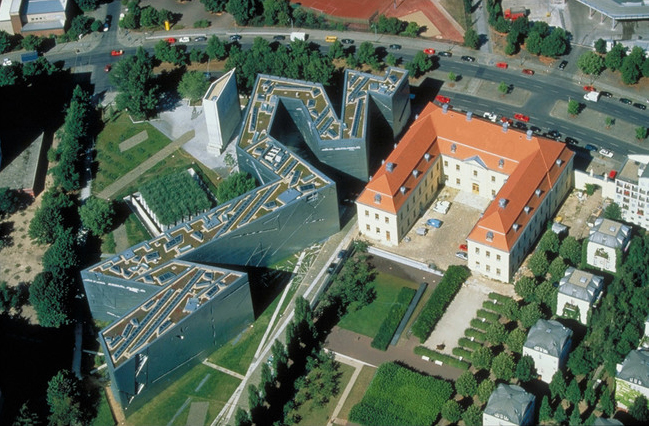
I suppose I was expecting another shocking tribute to the atrocities of war. I'm sure that can be found in this museum, but that was certainly not the only point. The building itself is giant (5+ floors of stuff) with gouges out the side that serve somewhat as windows.

[Not my pic, taken from the wikipedia page]
[Again not my pic. This is from the inside, during the day, out the slash windows]

[Again wikipedia source; the squiggle on the left is the museum (aerial view)]
Started at the top floor. This begins with the first mention of Jews in the area now known as Germany, in a proclamation dated something like the year 8, AD/CE, saying that Jews were no longer exempt from (onerous public duty whose name I forget).  I made it up through to just pre-WWII before the museum closed.  It was not exactly linearly laid out, so I have a few pictures of more modern things as well. 

There was a lot about various periods of persecution. I was surprised by something they didn't mention; they did mention that the Jews were blamed for the plague. They didn't mention that this was related to the Jews not really getting the plague so much, which I have heard attributed to the (ritual) hand washing before meals. 

Here's a pair of statues that apparently have shown up in many Churches (as statues or in paintings).  One represented Christianity(Ecclesia) and the other Judaism(Synagoga). Synagoga's blindedness is meant to portray that Judaism is "blind to salvation". No explanation of the broken lance she's holding, however.  There's a church in Strasbourg and also one in Bamburg that have these sorts of statues still:
Left: Ecclesia (the church;Christianity), Right: Synagoga (the synagogue;Judaism)
From Germany 2012-2013
There was quite a lot about Glikl bas Juda Leib (1646-1724), who had a ton of children, ran her husband's business after he died, and successfully married all of her children off to good families/business contacts. The museum didn't have a lot of originals of anything in the areas I saw, but it had a lot of very good facsimiles, including the re-written copies of Glikl's diary which her son had made. 

The early 1900s and on were a time where Jewish families were seen to be adopting more of the customs around them, e.g. Christmas trees, as a result of gaining more rights as citizens and integrating. Here's a comic (used as a tree ornament) poking fun at this development: 

"Darwinism"
From Germany 2012-2013

There were a lot of sort of mini-exhibits, character studies of various Jews of that time period. Here was one who was quite interesting:
From Germany 2012-2013

The label on the following bit says "Dildo box. Japan, jade, horn, metal wood. This dildo box is a remnant from the Institute of Sexual Research, which was destroyed almost entirely in 1933":

 They have a collection of Bar Mitzvah yarmulkes/kippahs which were pretty cute:
From Germany 2012-2013


And here's a wedding contract written in Chinese by a rabbi for a couple who were in exile in China, 1944:

From Germany 2012-2013


3. Dialog im Dunkeln
Understandably, I have no pictures of this, being a sort of "blind museum". Your tour guide is blind, and you're led through absolutely complete darkness by them. You get a walking stick, although i honestly made more use of my hands, groping along the wall and such. Rooms have things in them for you to find (e.g. spices, or fruits) and we even had a little boat trip (indoors) all navigated in the dark, with the helpful suggestions of our tour guide. I learned some new German through this.

die Gelände, which I knew before, means "grounds". E.g. "Messe Gelände" would be "Convention Center grounds".

das Geländer, which is pronounced almost identically to "Gelände", depending on the person, means "railing."

I spent a room or two wondering why the guy was telling us that there were "grounds" to our left or right. And then I bumped into the railing after he'd mentioned "Gelände(r)", and realized what he'd meant.

It was a bit scary, but I do make a regular habit of going around wherever I'm living in the (semi) dark, so it was not as foreign as it could have been.  The best/most challenging really was the end, where we were in a "dark bar". The servers were all blind, and fetched us something to drink or a snack, which we then had to pay with with the change (1 or 2 euro coins, hopefully) we'd been told we should bring with us. They could tell the coins by feel immediately.

The only trouble was the one guy who brought in a 10 euro note. He wasn't 100% sure it was a 10 euro note, so the guy taking it had to get out his ''comparison'' bills:  So, each euro bill is a completely different size. This is great, if you have them all together to compare against each other. Our guide said that his solution is to get the ATM to give him only two kinds of bills (so he knows which is which since he knows which value is the larger/smaller).  I bought a box of chocolate milk, and had some real trouble figuring out where (and how) to stick the straw in, which the woman serving me helped me find in no time flat.

We had a bit of a Q&A then, and the most interesting question was why some people opt to not have guide dogs. The dog starts training at about 1 y/o, the training is about 10 months, which you (the future owner) have to participate in. It's all pretty expensive. Then the dog lives on average to be about 7 years old. He said losing such a dog is worse than losing a lover, because the extent to which you depend on that dog is so great. So, he (and many others) opt to just use a stick instead.

4. Emigration Museum
Ballin Stadt is the name of the museum, but more of where it is housed. It's located in the last remnants of former company housing for people waiting to emigrate to the states. Most of the people who passed through were not German, just people needing a port to leave through. Bremen/Bremerhafen was a much bigger through-port first, since Hamburg viewed emigrants as a nuisance and potential plague vector.  The building of these barracks was part of them coming to grips with needing to provide housing for these people, especially if they were going to require extensive quarantine, and try to keep the people away from the town proper.

They seemed exceedingly proud of the fact that they had doctors check the people daily (for ~2 weeks before departure). To be fair, if someone was refused entry to whatever country and shipped back, it would cost the company (all of these barracks and whatnot were paid for by the company that specialized in shipping people across the ocean).

The part of this photo that's colored is the current museum (3 buildings and some land)
From Germany 2012-2013

It starts of with stories from various emigrants. This one is a mix of funny and tragic:

From Germany 2012-2013

An early form of entrance papers (to the states). Note that Bohemian is listed as a language:
From Germany 2012-2013

There were a lot of rat plush toys amidst the various displays:
From Germany 2012-2013


A graphic of all the stuff a ship had to take with it on a trans-atlantic journey:
From Germany 2012-2013

I find this next thing a bit weird/creepy.
The bottom says "Uncle Sam stands for the United States. He is the Spirit and Soul of America. Be loyal to him and you will be a true American". (What???)
From Germany 2012-2013


5. Deichstraße

Before looking at pretty houses, we stopped by the Portuguese Quarter for lunch and picked a random Cafe. The drink is traditional, a Galao, which is kind of like a latte. Good, all around, and very affordable. Here's lunch:
From Germany 2012-2013


En route there, we passed these buildings that I always think of as somehow ship-like:
From Germany 2012-2013


Pretty houses. Not much to say besides that these are some of the oldest (still) standing in Hamburg. They've been renovated twice. Once after the great fire in 1842 (which started on that street, funnily enough) and then after the war. A bunch of shops were closed, and said to be closed for all of January.

first view
From Germany 2012-2013


Hamburger Burgerhaus: because someone had to do it :) (it is, in fact, a restaurant serving burgers)
From Germany 2012-2013
The leaning is in fact the house, not me. 
From Germany 2012-2013
This place claims to be the start of the great fire, but that was actually a few buildings down (so says the blue plaque)
From Germany 2012-2013
There was a small street/alley one could walk down to the water. Here's a view of Deichstraße from the back, as it were: 


Wednesday, December 12, 2012

Rotterdam

After Amsterdam, I spent some time visiting friends who I'd visited last I was in Amsterdam, and who now live in Rotterdam. Rotterdam's downtown is full of some crazy cubist buildings and other interesting architecture. It was flattened by Germany during WWII as a way of getting an unconditional surrender out of them. That is, it went roughly like this:

Germany:  "Surrender unconditionally, or we'll bomb Rotterdam" 
Netherlands: "No"
*Bombed Rotterdam* 

Rotterdam city center afterwards

Germany:  "Surrender unconditionally, or we'll bomb Utrecht and Amsterdam as well".
Netherlands: :/ Fine. 

As a result, they had a lot of city to rebuild.  The rebuild was led by an American city-planner, which is who takes the blame/credit for the way it looks now. 


Aside: in skimming Wikipedia's entry on History_of_the_Netherlands_(1939-1945), learned some interesting things:

  • Amersfoort, which is now a common train stop/change place, was home to a camp. 
  • Everyone in the Netherlands who was male and between 18 and 45 was forced into manual labor. 
  • The exiled government of the Netherlands was given the same deal as France, which was to come back and rule as a puppet government. The Prime Minister was interested, but Queen Wilhelmina was having none of it, and dismissed him as a result. Result: entirely German-run Dutch government. [Aside: I had a neighbor from the Netherlands, with two Keeshonds ("Kayz-hond"). One was named Wilhelmina. Is that a proud or mocking thing to do? Unsure.] 
Additionally, not about the war: 
  • It was possible to (almost) make an island out of Holland by destroying dikes and flooding the "polders". (via the "Dutch Water Line". )

  • Following various floods, separate governing "water boards" (of people) were set up to oversee the maintenance of the Dutch defenses against water.  "Water bodies hold separate elections, levy taxes and function independently from other government bodies. Their function is basically unchanged even today. As such they are the oldest democratic institution in the country."  (from Wikipedia's "Flood Control in the Netherlands"). 
  • There's a lot in the flood-control wiki page about the development of dikes, etc in the Netherlands, starting in the 9th Century or so, which I thought was pretty neat. "Current dikes are made with a core of sand, covered by a thick layer of clay to provide waterproofing and resistance against erosion...Up to the high waterline the dike is often covered with carefully laid basalt stones or a layer of tarmac. The remainder is covered by grass and maintained by grazing sheep. Sheep keep the grass dense and compact the soil, in contrast to cattle."(ibid)


Ok, back to crazy buildings:
Downtown Rotterdam, cubist buildings middle/left
From Amsterdam Dec 2012


View from underneath of crazy cubist apartments.
From Amsterdam Dec 2012

Apparently one of the apartments is open for viewing, but you can't get up there unless you're nimble, and we were sort of just strolling about, with a stroller (my friends have an infant, who was pretty mellow during our walk in the cold). 

Random:

From Amsterdam Dec 2012


One oldish building was kept up, and turned into the Rotterdam history museum:


I think it looks nicely incongruous. 
From Amsterdam Dec 2012

The city center also had a "shopping ditch" (for lack of a better translation), which I thought was actually pretty nice when you went in/down.

From Amsterdam Dec 2012


Here's some nice tradition juxtaposed with new/weird buildings: The stand is for some fried delicacy of the Netherlands, whose name is escaping me. It's not poffertjes. Anyway, this is apparently (one of?) the best such stand around. It would totally fit in at the Hamburger Dom:
From Amsterdam Dec 2012

Another view of the same square/open area:
From Amsterdam Dec 2012

And another. The red lanterns were due to a chinese-themed something-or-other happening in town at night, starting about when I rolled into town. Here's a website about it. Apparently it continues until Valentine's day.
From Amsterdam Dec 2012


The big, factory-esque building in the background of the next picture is the Rotterdam library.

It reminded me of the Bielefeld university building, inasmuch as the theme for both were "Factory"; I think the library in Rotterdam succeeded at interpreting the theme a bit more cheerfully.

The stuff going on in the mid and foreground are a market of sorts, selling everything from fabric (presumably, by the meter) to fruits and vegetables, christmas trees/wreaths, and the same amazing/terrible stockings-paired-with-matching skirt that were patterned like a Granny/Christmas sweater, but with a feel of 80s videogames (I think the black background and bright colors are what made me think this).
From Amsterdam Dec 2012

To be honest, I put off writing about the trip as I had a bit of a grumpy ride home. Travelling (in the winter, in Europe) is not always sunshine and rainbows.

===================
The ride home. Here are a few things that happened:

After two transactions in Amsterdam, my bank locked my EC(i.e. debit) card, which I wasn't sure about until the day I was heading back to Germany. I'd taken out enough cash before the trip, so it wasn't a big deal, until...


I took the train at 6pm or so out of Rotterdam. The first train was fine and good, and I ended up in Duisburg, waiting for my next train. DeutscheBahn had some signal outages (which I was told are quite common -- is this part of the trains not being weatherproof?), which created a final delay on my train by 80 minutes. It was, of course, the last train to Hamburg from Duisburg. 


By then, I had 4 euros on me, and became certain my card was locked when it wouldn't run at Starbucks at the station (I was going to get a little hot chocolate to pass the time). I didn't call my bank, as their customer service is something like 10 cents per minute (unlike the states, I have yet to see a customer support number that's free) and probably doesn't speak English, at least as late at night as I realized it.

Also, due to the delay, the train would put us in Hamburg after the U-Bahn lines stopped running and the only transit was the night buses, which only ran once per hour. So, I'd have to hail a cab (which I wasn't sure DeutscheBahn'd pay for), and me with only 4 euros on me.  I figured, well, I'm going to have to (cross my fingers that it works and) use my American ATM card to withdraw enough cash to hire a cab.

I was getting a bit worked up, and the train finally got there. I boarded the (correct) train, and started freaking out because they kept announcing that it was (only) going to Dortmund, and another delayed train *also* going to Dortmund was leaving on the same tracks, so I was worried that I'd messed up. At the 1st stop (Essen), I leaned my head out and realized I was on the correct train after all, so sat back down. When a conductor (Schaffner) went by, I asked about it and he said we had to cross over to another train in Dortmund. I *had* remembered correctly, and our train was originally supposed to be two pieces, and here was the second half. I don't know what the people inside the train already have been through, but hopefully they were in the cozy train for the 80 minutes instead of out on the tracks.

At the end of all this, DeutscheBahn did in fact pay for a cab for all of us to get home. That was pretty great. Once in the cab, when I had to open my mouth to direct the driver to where I needed to go, the driver called me out as American in no time flat. He told me he liked the US, and the 'lifestyle'. I said I didn't, but was too tired to say anything else. 

====================

Amusingly enough, we had just discussed the preceding week in my German class what to do when you're on the wrong train, and what happens when the train is delayed (you get to fill out a form with rather vague statement/questions in German to answer).

Tuesday, December 11, 2012

Amsterdam, we meet again

The premise of this trip was that two friends of mine were married in October, and are now honeymooning in Europe, and we agreed on Amsterdam as a place to meet, since Hamburg was far from where they were aiming (Bruges/Paris/Lyon). I'm glad we picked that. It was nice to see Amsterdam again, and new things there as well.


En Route: 

I decided to take the train from Hamburg to Amsterdam. I'd thought about taking a plane, but there are certainly advantages to the train. Half as expensive (at worst), more laid back, more room in your seat, if you miss a train you take the next, see some countryside, and I usually manage to get a bit of work done on the train. 

Some signs I noted when I crossed over into the Netherlands: 
  • The train crossing has a line of cars, adjacent to a line of bicyclists, waiting. 
  • There is water on at least one side of the train tracks. 
  • The signage (Oost instead of Ost, etc.) changes. 
  • The announcements start in Dutch, then follow in German and then English. 
And, of course, all the people who board at the subsequent stops are speaking in Dutch. I overheard someone use the word 'bizarre' and wondered if it's borrowed from Dutch. Nope. 

To learn German-based English vocabulary, it's probably better to learn Dutch than German, since English split from German before Hochdeutsch was the standard. That is, it's closer to one of the forms of Plattdeutsch, which are closer to Dutch. (e.g. Drübbel  (clearly, => dribble)). And the words that are 'clearly' German are all Plattdeutsch:  
  • Apple strudel (hochdeutsch: Apfelstreusel)  
  • Dachshund (hochdeutsch: Dackel)  
  • Dyke ( Dutch: Dijk, German: Deich) 
  • Apple (dutch: Apel, german: Apfel)


Getting in:

I'd suggested trying out something from airbnb, a website where people who only use their apartments infrequently can offer them (or a spare room, even) up as a 'self-serve' sort of bed and breakfast. I got in first, of the three of us, by about an hour, and went straight to the apartment. 

Amsterdam Centraal Station
From Amsterdam Dec 2012


I met the guy who owns/rents it, he showed me around, and pointed out the fridge and cabinets full of breakfast foods that we could eat (yogurt-flavored and unflavored, fromage blanc, eggs (large &small), super thin bacon, bio müsli, müsli with lots of fruits and nuts, 'crunchy müsli' (i.e. granola -- I've seen it called 'knusper müsli' and 'crüsli' as well (crunchy müsli)), and lots of fruits -- bananas, apples, oranges with the leaves attached, a ripe avocado, mangos, kiwis and a persimmon.  I'd never tried persimmons before, apparently they're delicious. 

When the others got in,we went to find something to eat and ended up at an Argentinian steakhouse (which are everywhere!) because the restaurant I'd wanted to try was booked solid. I checked online later and they had an online reservation form and time for Sunday, so I booked a 19:00 dinner.

Canal view as we walked back from the restaurant
From Amsterdam Dec 2012


We finished up the day with some bizarre American TV (I think it was called 'My strange obsession'). 


Day 1: 

To help with the jet-lagged friends, I got up way too early and started making coffee/espresso. And more. And more. When people were mostly done with their showers, switched to food. 

We had a make-espresso-on-the-stove pot, which I hadn't used prior to this. Works quite well, I think, although it probably helped that we were using a gas range. The 'stove'/range was a gas stove, no oven attached (underneath is a dishwasher), and it also had a very strong exhaust fan above, which made me quite happy to fry up the super-awesome bacon without feeling like a piece of bacon myself all day, and some scrambled eggs.

Our itinerary for the day:

  1. Canal tour 
  2. walk around 
  3. eat lunch at Latei 
  4. Red light district
  5. pop-up Christmas market 
  6. (Genever distillery -- this was added during the day)
  7. dinner @ Moeders 
  8. Amsterdam festival of lights

After breakfast, we took the tram (which I bought a day pass for) up to Centraal station and bought a 1hr canal tour ticket via this company, which we had to wait half an hour for, due to our timing.

Amsterdam loves bicycles(fiets). And that's just a small portion of the bicycle parking by the central station.
From Amsterdam Dec 2012


And then the rain really got worse, so the first bit and piece of the canal tour, it was really hard to see anything. It had four (recorded) languages (Dutch, English, Italian, Korean) narrating, and before the trip you can request some (max of 4) out of their collection of 13. 

Sign on the boat (French and German both call tipping 'drink money')
From Amsterdam Dec 2012
Some views down canals once the weather cleared:
From Amsterdam Dec 2012

Two boats (row boat on the right), a dutch flag and birds:
From Amsterdam Dec 2012


Here's a view of a big courthouse (Palais de Justice)
From Amsterdam Dec 2012


After the tour, we walked around a bit.

Here's part of the water near the central train station. It seems a bit trusting for the windows to be so close to the water:

From Amsterdam Dec 2012


A lot of the buildings lean left right, and/or forwards. Here's a good example:

From Amsterdam Dec 2012


A quintessential canal view (canal in dutch is 'gracht'):
From Amsterdam Dec 2012


I don't know the point of these, but they look cool:
From Amsterdam Dec 2012

We learned on the canal tour that the old buildings of Amsterdam were known for their gables, with these hook/winch things above, that were used historically to haul stuff into the warehouses. That is, it seemed like most of old Amsterdam was warehouses. Maybe people lived or worked in the ground floor?

From Amsterdam Dec 2012


Also went into a cool liquor store, where the owner approached me and asked "English? French? German?" (clearly he's Dutch; I'm impressed that he speaks 4 languages). Nearby was this sign:

slijterij = liquor store (so says Google)
From Amsterdam Dec 2012
Wandering towards where we intended to eat lunch, we ran into what seemed to be a mini chinatown area.

From Amsterdam Dec 2012


From Amsterdam Dec 2012


This sign was on the temple:
bicycles will be removed
From Amsterdam Dec 2012


Stopped at Latei for lunch, kooky place where everything in the store (not the people or their cat) is for sale. Smelled amazing, food delicious.

Here are a few views:

From Amsterdam Dec 2012


From Amsterdam Dec 2012


When we left, this sign said goodbye:
From Amsterdam Dec 2012


We walked past what was some kind of tour. The 'xxx' is the prominent feature of the flag of Amsterdam.

From Amsterdam Dec 2012


Next stop, the Red Light district. You are warned to not take pictures of the ladies, if you would like to retain your camera. So, I have no pictures of that.  If you look in the following picture, however,  to the left is a building that appears to be normally used for this but under renovation. The most exciting thing in the window now is the guy who's a painter or workman, up on a ladder.  I liked the shutters on the house to the right of the erotic museum:
From Amsterdam Dec 2012

Here's a closeup of the plaque on the building:

God is my neighbor?
From Amsterdam Dec 2012

nice view up the canal from the red light district.
From Amsterdam Dec 2012

We saw a window of underwear and a confused penguin:

From Amsterdam Dec 2012


Here's a house at the edge of the redlight district. I like the stripes:

From Amsterdam Dec 2012


Walking along, looked down an alley to see this:

From Amsterdam Dec 2012


Homomonument. Once we got there, we figured out the three pink triangles were all on the ground, and quite large. Here's the main one:


From Amsterdam Dec 2012

it has a nice view:
From Amsterdam Dec 2012


We stopped at a cheese store nearby, nestled into a church, where the church bookstore had probably been. I got some pesto-gouda, and my friends got chocolate (and cookies?).


We stopped in various knick-knack stores, including Dam souvenirs (at Dam square):
these people are serious about their shoes
From Amsterdam Dec 2012


a shoe outside the same store. You could probably stash an infant in there. 
From Amsterdam Dec 2012


And a shopping center (located behind Dam square), which I found very pretty:

From Amsterdam Dec 2012

Random whale (near 'By Popular Demand', cool odds-and-ends store that'd fit right in in Austin):
From Amsterdam Dec 2012


Walking, crazy weather changes. Windy, huge gusts, rain, pouring rain, drizzle, bit of sun and blue sky, rain, dry but windy. Etc.

Dutch for coffee seems to be 'koffie', but used to be Coffy, from this sign?
From Amsterdam Dec 2012

En route to the  'pop-up-christmas market', came across this super duper lopsided building:
From Amsterdam Dec 2012


A view back along Bloemenstraat (the street the market was on):

From Amsterdam Dec 2012

I didn't take any pictures of the market. It was tucked into a narrow, not-too deep room opening out to a street. The smokers were standing right at the door, probably because it had been raining. We had to fight a bit to get in and out. There really wasn't that much for sale. Most of the room was taken up by people sitting and eating/drinking (we bought some cider. There were also pastries for sale) and an empty stage area with a schedule of people/bands to play.

Nearby:
...
From Amsterdam Dec 2012

We saw several of these tiny cars (maybe half the size of a smart car) around:
From Amsterdam Dec 2012

Here is no place for bicycles (except the tape variety)
From Amsterdam Dec 2012


Ended up at Vondelpark briefly, which is named after Joost van den Vondel,  a 17th century Dutch author. I'd thought 'Vondel' was like 'Wandel' and it was a walking/wandering park.

From Amsterdam Dec 2012
We don't go far inside, though.

We then headed over to Museumsplein. Here's the back of the Rijksmuseum, which is clearly still under construction now (3 years later):
From Amsterdam Dec 2012


Nice murals on the side:
From Amsterdam Dec 2012

Took some cheesy tourist photos.

From Amsterdam Dec 2012


Went to find a restroom,

bizarro glass on the restroom door
From Amsterdam Dec 2012

On the wall as you walk into the building, we saw an advert for a (nearby) Genever (Dutch forerunner of Gin) distillery that offered tours all the time, including a cocktail and tasting in the ticket price,  'House of Bols' ('Bols' sounds funny. Here's google saying it). Headed on over it to it, as we had some spare time (since the christmas market didn't take that long). It was nice. Strange. The theme of the 'exhibit/museum-y part was 'You taste what you see/smell/touch'.

Some Bols family history:
From Amsterdam Dec 2012

Turns out Genever was introduced to the states in like 1820 or so (way before Gin/Gin was around). Apparently we invented the cocktail, and a lot of original cocktail recipes used Genever 'for its fine mixing properties'.

Bit of advertising where they claim their bottle is scientifically awesome:
From Amsterdam Dec 2012

A schematic:
From Amsterdam Dec 2012


And a video explaining that they'd designed their super efficient-for-pouring bottle with input from real bartenders!
From Amsterdam Dec 2012


The evolution of their Genever bottles:

From Amsterdam Dec 2012

Their 'original' (maybe longest surviving?) Genever recipe:
From Amsterdam Dec 2012


KLM gave (gives?) out little delft houses full of Genever to 1st class passengers. At some point it became illegal to give away (hard?) alcohol, but they still sell (sold?) them:

From Amsterdam Dec 2012


Sign to the post-tour cocktail room:
From Amsterdam Dec 2012

Had an 'Original Collins' (saved the recipe, which is also here). That and a 'tasting' were included in the tour price of about 12 euro. Delicious.

It's also a bartending school, so there's a 'flair' booth where you can pretend to be a bartender and throw some bottles around, and there's two bartenders-in-training serving us drinks.

From Amsterdam Dec 2012


The post-cocktail tasting was two shots of whatever you wanted that they had. I chose 'the genever that was in the drink' and an oak-aged one (on the right; Bols Corenwyn -- pic of the bottleGin):
From Amsterdam Dec 2012
The internet tells me that "Only Bols is permitted to use Corenwyn as a brand name because it was Lucas Bols himself who first created the drink back in 1575. "

Here's a blog post on the history of Genever.


After that, we just missed a tram, and instead walked back to Moeders (Mothers) for delicious Dutch food. Yum Yum.
From Amsterdam Dec 2012

Menu says if your mother comes in on her birthday, we have a special surprise, which seems to have happened while we were there.

All of the walls are covered (and the window sills as well) with pictures of mothers:
From Amsterdam Dec 2012

Our delicious Dutch spread:

From Amsterdam Dec 2012

This was what the menu recommended as 'traditional dutch food', the  Hollandse Rijsttafel, 
``een combinatie van ons suddervlees, hachée & stamppotje.
compleet met gekookt aardappeltje, rode kool, appelcompote,  stoofpeertjes, spekjes, rookworst & jus.  ''

Dishes, clockwise, starting above the beer on the left:
  1. (stamppotje) mashed potatoes&carrots, with superthin bacon and a sausage
  2. (appelcompote) mashed apples 
  3. (gekookt aardappeltje) boiled potatoes
  4. two pots (middle) of stewed beef 
  5. stewed pears (you can only see a bit in the picture)
  6. (rode kool) red cabbage with apple 
  7. baked/oven-fried potatoes
After dinner, we took our leftovers (enough for another meal!) back to the (very near) apartment/bnb, then went out for the scavenger-hunt-esque walk along the amsterdam 'festival of lights'. it was more fun finding the things than seeing them. More crazy rain and wind gusts interspersed. 


Merry christmas sign (in Dutch):
From Amsterdam Dec 2012


From Amsterdam Dec 2012


From Amsterdam Dec 2012


Festival of lights. First one was hard to find:
From Amsterdam Dec 2012


From Amsterdam Dec 2012


From Amsterdam Dec 2012


From Amsterdam Dec 2012


My favorite was this netting:
From Amsterdam Dec 2012

Video of the netting blowing in the wind (link in case the embedding doesn't work):

From Amsterdam Dec 2012

From Amsterdam Dec 2012


From Amsterdam Dec 2012

From Amsterdam Dec 2012


Day 2, figured out how to make a cappuccino. 
Figured out how to math frothy milk and added that to the espresso. Yum.

Also, went (back) to the Albert Cuypmarkt. Had been here 3 years ago,when I had first visited Amsterdam (en route to Belgium). It's about 1km long and sells all kinds of things. 

One of my friends had been entranced by the back-tire locks I'd mentioned (and then pointed out) and stopped and bought one (for 8 euros). These look like the one in this picture, the black thing on the righthand side (not the lock-chain on the left)[Picture taken from someone else's blog entry about Amsterdam cyclists and cycling habits. Good pictures.]

I was tempted by some really cheesy clog-slippers (hey, I don't have any warm/soft houseshoes) as well as some nice scarves; I did buy a small flexible tripod (6 euros) to play around with with my camera. 

I also found (gasp!) an authentic belgian waffle stand! (Wally's Wafels, also on facebook) Made fresh, Brussels-style. I walked up and asked him if he made them fresh. He said yes, of course, and these are Brussels-style (which *have* to be made fresh). So, I explained to my friends the difference between Brussels and Liege-style waffles, with the waffle guy chiming in here and there as he made my waffle. He made a little too much (so, effectively 1.5 waffles) and gave the extra piece to my friends, with a wink. So light! and crunchy! Yum!

[Someone else marveling over the waffles, with a picture. I was too delighted to stop and waste my time taking a picture of my delicious waffle].


We came across this walking back to the tram: 


We like to serve you every day...
From Amsterdam Dec 2012

I still think there are more bicycles in Copenhagen, but I'm not as sure as I was before this trip. The Copenhagen cycling lanes are certainly bigger and nicer than the Amsterdam ones, which are quite nice any way. We saw a cleaning car/cart driving down the bike lane one of the mornings. 

This is the problem with German bike lanes -- they're on the sidewalks, and (therefore) not cleared as often as the car lanes. So, biking in the winter is a gamble. 

After this, I headed to the station to meet the friend's I'd visited in Amsterdam 3 years ago (they're now in Rotterdam). Tot ziens!