I'll sort these in reverse chronological order, for no real reason outside of the most recent things being what I probably have the most to say about. To be fair, a good bit of some of it is just pictures, so it shouldn't be as monstrously long as it seems.
- Hamburg's Museum der Arbeit (Museum of Work)
- Berlin Unterwelt Tour: Cold War era and (Berlin) Jüdisches Museum
- Dialog im Dunkeln (I might call this a "blind museum")
- Ballin Stadt (Museum for Emigration through Hamburg to North and South America)
- Deichstrasse (pretty and old houses in Hamburg, rare sight indeed)
I was visited by a friend who is (back) in Germany doing more research towards her Ph.D. This was the first weekend of 2013; we went to the Emigration museum, Deichstrasse, and the Dialog im Dunkeln. It was a bit of a busy day.
1. Museum der Arbeit
Last weekend, we looked up the list of Hamburg museums and picked one that looked interesting. This ended up being the Museum der Arbeit.
The museum itself is housed in what used to be a hard-rubber factory for the
New-York Hamburger Gummi-Waaren Compagnie AG . Here's there awesome neon logo:
Accordingly, there's a section of the museum dedicated to the discovery and development of rubber, from its infancy and initial uses for just about everything to the exportation of rubber plants and a small amount of commentary on exploited workers (the harvesters of the raw material were enslaved natives). The raw material is called "Kautschuk".
 |
| Cool new material, what should we do with it? Make statues of course! |
|
| From Germany 2012-2013 |
Here are four stages of worked rubber, from somewhat raw, to heated. These are/were the initial steps towards turning it into, say, a comb (the label says "Kautschak auf dem Weg zum Kamm" -- pre-rubber on the way to (becoming a ) comb) .
I'm a sucker for big old maps, so here's one in case you are as well. Probably can't see from this, but Russia and Siberia are labeled as if they were different lands (maybe they were then).
Here's a travel poster that is in the map vein as well:
The museum went on from all the crazy stuff you can make out of rubber to how people visited the places where it was made, the form it took when shipped, and other things one exported from these places (like cocoa beans). Here's an awesome travel suitcase:
After this were machines of various ages. Two children, maybe 10 or so, were happily and loudly banging away on some old German typewriters. It's good that those things can take a beating. I did a loop of the floor, and I think the kids were there for at least half an hour, kind of amazing they found it that entertaining. While I was near, a lady felt the need to come up and tell them that typewriters are what pre-dated computers.
Nearby was also an old calculating machine that was at first glance a bit complicated. You were allowed to play with this one as well:
Down the way were the big machines. First, a ginormous press for newspapers and such:
There were also a working Monotype machine and a working Linotype machine.
Here's the Monotype machine setup:
 |
| Closer up on the keyboard. Top row was cursive. I don't remember the difference between the green and white keys. |
|
| From Germany 2012-2013 |
This thing (which he called the/a matrix) is used by the setup to the write to figure out letter spacing. The output of the machine is a line of metal (iron) letters, like those in the right/upper part of the picture:
I took a video (small enough I could upload it and get it to play) of the Monotype machine working (warning: quite loud):
I checked out another floor of the museum, which was about professions and how they've changed (e.g. copper smith, roof-builder, etc.). This was my favorite display:
This was a bit random. I like translating "Gewinn" as "win", but it's more like "profit, gains".
Something else. According to them, Konrad Zuse in 1941 developed the first fully programmable computer in the world, the Z3. I've never heard of this guy, but apparently
Wikipedia agrees.
["His greatest achievement was the world's first functional program-controlled Turing-complete computer, the Z3, which became operational in May 1941."]
2. Berlin Underworld Tour: Cold War era, Jüdisches Museum
These two go together because the happened the same weekend, two weekends ago.
(i) Underworld Tour
I have no pictures of the Unterwelt Tour, sadly, since we weren't allowed to take any. I'd still like to comment on it.
The tour we went on was
"Tour 3": Subways, Bunkers and Cold War. The English tours that day were, of course, all sold out, so I plunged in with a German one and tried to stand as close as possible to the tour guide in hopes of being able to hear him clearly. Also -- they hold one French tour per day, and have several other languages offered on and off during the week, which is pretty cool.
The premise of all this is the following: Berlin has a lot of retired bunkers/bunker-like spaces spread around various U-Bahn stations on the very eastern edge of West Berlin. After WWII, with the advent of the cold war, people thought that they should be prepared in the case of WWIII/a nuclear catastrophe. Berlin as a town for this to happen in would be weird, I think, being so divided between countries. Maybe this was part of the rationale behind their being
utterly unprepared. Between all of the shelters in the town, they could hold something like less than 1% of the population, for some duration of time. Comments that were made: Switzerland had ~140% capacity. That is, their population + another 40%. Sweden was something like 99%.
The first bunker we entered wasn't finished (funding?), so was labeled as a place where you should hide out for at most 10 hours. Why? Well, no water, minimal air circulation/filtration and no other supplies.
The second bunker was a bit more practical. It was outfitted for exactly 14 days worth of fuel to power the air pumps/filters, food to feed people, etc. Lots of beds, and the train stop it was built around also had special bed-filled cars (if I understood correctly).
The trippiest part is that these are all nestled in/above/around
active train stations. Tons of people walk by these doors ever day and have no idea that there are retired bunkers behind them.
(ii) Jüdisches Museum
I suppose I was expecting another shocking tribute to the atrocities of war. I'm sure that can be found in this museum, but that was certainly not the only point. The building itself is giant (5+ floors of stuff) with gouges out the side that serve somewhat as windows.
 |
| [Again not my pic. This is from the inside, during the day, out the slash windows] |
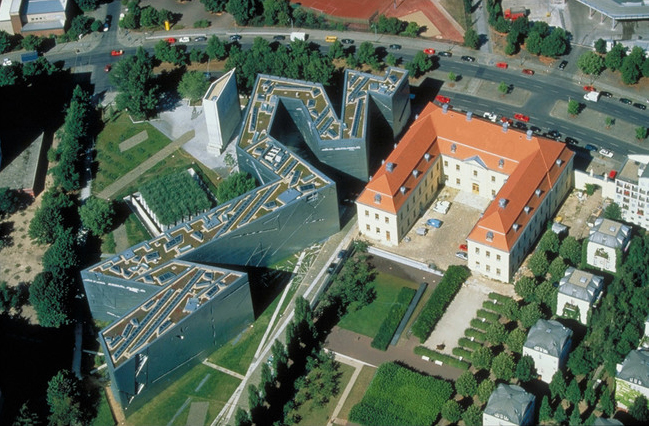 |
| [Again wikipedia source; the squiggle on the left is the museum (aerial view)] |
Started at the top floor. This begins with the first mention of Jews in the area now known as Germany, in a proclamation dated something like the year 8, AD/CE, saying that Jews were no longer exempt from (onerous public duty whose name I forget). I made it up through to just pre-WWII before the museum closed. It was not exactly linearly laid out, so I have a few pictures of more modern things as well.
There was a lot about various periods of persecution. I was surprised by something they didn't mention; they did mention that the Jews were blamed for the plague. They didn't mention that this was related to the Jews not really getting the plague so much, which I have heard attributed to the (ritual) hand washing before meals.
Here's a pair of statues that apparently have shown up in many Churches (as statues or in paintings). One represented Christianity(Ecclesia) and the other Judaism(Synagoga). Synagoga's blindedness is meant to portray that Judaism is "blind to salvation". No explanation of the broken lance she's holding, however. There's a church in Strasbourg and also one in Bamburg that have these sorts of statues still:
 |
| Left: Ecclesia (the church;Christianity), Right: Synagoga (the synagogue;Judaism) |
|
| From Germany 2012-2013 |
There was quite a lot about Glikl bas Juda Leib (1646-1724), who had a ton of children, ran her husband's business after he died, and successfully married all of her children off to good families/business contacts. The museum didn't have a lot of originals of anything in the areas I saw, but it had a lot of very good facsimiles, including the re-written copies of Glikl's diary which her son had made.
The early 1900s and on were a time where Jewish families were seen to be adopting more of the customs around them, e.g. Christmas trees, as a result of gaining more rights as citizens and integrating. Here's a comic (used as a tree ornament) poking fun at this development:
There were a lot of sort of mini-exhibits, character studies of various Jews of that time period. Here was one who was quite interesting:
The label on the following bit says "Dildo box. Japan, jade, horn, metal wood. This dildo box is a remnant from the Institute of Sexual Research, which was destroyed almost entirely in 1933":
They have a collection of Bar Mitzvah yarmulkes/kippahs which were pretty cute:
And here's a wedding contract written in Chinese by a rabbi for a couple who were in exile in China, 1944:
3. Dialog im Dunkeln
Understandably, I have no pictures of this, being a sort of "blind museum". Your tour guide is blind, and you're led through absolutely complete darkness by them. You get a walking stick, although i honestly made more use of my hands, groping along the wall and such. Rooms have things in them for you to find (e.g. spices, or fruits) and we even had a little boat trip (indoors) all navigated in the dark, with the helpful suggestions of our tour guide. I learned some new German through this.
die Gelände, which I knew before, means "grounds". E.g. "Messe Gelände" would be "Convention Center grounds".
das Geländer, which is pronounced almost identically to "Gelände", depending on the person, means "railing."
I spent a room or two wondering why the guy was telling us that there were "grounds" to our left or right. And then I bumped into the railing after he'd mentioned "Gelände(r)", and realized what he'd meant.
It was a bit scary, but I do make a regular habit of going around wherever I'm living in the (semi) dark, so it was not as foreign as it could have been. The best/most challenging really was the end, where we were in a "dark bar". The servers were all blind, and fetched us something to drink or a snack, which we then had to pay with with the change (1 or 2 euro coins, hopefully) we'd been told we should bring with us. They could tell the coins by feel immediately.
The only trouble was the one guy who brought in a 10 euro note. He wasn't 100% sure it was a 10 euro note, so the guy taking it had to get out his ''comparison'' bills: So, each euro bill is a completely different size. This is great, if you have them all together to compare against each other. Our guide said that his solution is to get the ATM to give him only two kinds of bills (so he knows which is which since he knows which value is the larger/smaller). I bought a box of chocolate milk, and had some real trouble figuring out where (and how) to stick the straw in, which the woman serving me helped me find in no time flat.
We had a bit of a Q&A then, and the most interesting question was why some people opt to not have guide dogs. The dog starts training at about 1 y/o, the training is about 10 months, which you (the future owner) have to participate in. It's all pretty expensive. Then the dog lives on average to be about 7 years old. He said losing such a dog is worse than losing a lover, because the extent to which you depend on that dog is so great. So, he (and many others) opt to just use a stick instead.
4. Emigration Museum
Ballin Stadt is the name of the museum, but more of where it is housed. It's located in the last remnants of former company housing for people waiting to emigrate to the states. Most of the people who passed through were not German, just people needing a port to leave through. Bremen/Bremerhafen was a much bigger through-port first, since Hamburg viewed emigrants as a nuisance and potential plague vector. The building of these barracks was part of them coming to grips with needing to provide housing for these people, especially if they were going to require extensive quarantine, and try to keep the people away from the town proper.
They seemed exceedingly proud of the fact that they had doctors check the people daily (for ~2 weeks before departure). To be fair, if someone was refused entry to whatever country and shipped back, it would cost the company (all of these barracks and whatnot were paid for by the company that specialized in shipping people across the ocean).
 |
| The part of this photo that's colored is the current museum (3 buildings and some land) |
|
| From Germany 2012-2013 |
It starts of with stories from various emigrants. This one is a mix of funny and tragic:
An early form of entrance papers (to the states). Note that Bohemian is listed as a language:
There were a lot of rat plush toys amidst the various displays:
A graphic of all the stuff a ship had to take with it on a trans-atlantic journey:
I find this next thing a bit weird/creepy.
 |
| The bottom says "Uncle Sam stands for the United States. He is the Spirit and Soul of America. Be loyal to him and you will be a true American". (What???) |
|
| From Germany 2012-2013 |
5. Deichstraße
Before looking at pretty houses, we stopped by the Portuguese Quarter for lunch and picked a random Cafe. The drink is traditional, a Galao, which is kind of like a latte. Good, all around, and very affordable. Here's lunch:
En route there, we passed these buildings that I always think of as somehow ship-like:
Pretty houses. Not much to say besides that these are some of the oldest (still) standing in Hamburg. They've been renovated twice. Once after the great fire in 1842 (which started on that street, funnily enough) and then after the war. A bunch of shops were closed, and said to be closed for all of January.
 |
| Hamburger Burgerhaus: because someone had to do it :) (it is, in fact, a restaurant serving burgers) |
|
| From Germany 2012-2013 |
 |
| This place claims to be the start of the great fire, but that was actually a few buildings down (so says the blue plaque) |
|
| From Germany 2012-2013 |
There was a small street/alley one could walk down to the water. Here's a view of Deichstraße from the back, as it were:


Cool!
ReplyDelete(she drinks)
;)